Full trace
Ordered steps permit local support checks, inference checks, and inspection of visible dependencies.
Visible structure does not establish the mechanism of hidden computation.
Under review at ACM Computing Surveys. Literature cutoff: 30 August 2026.
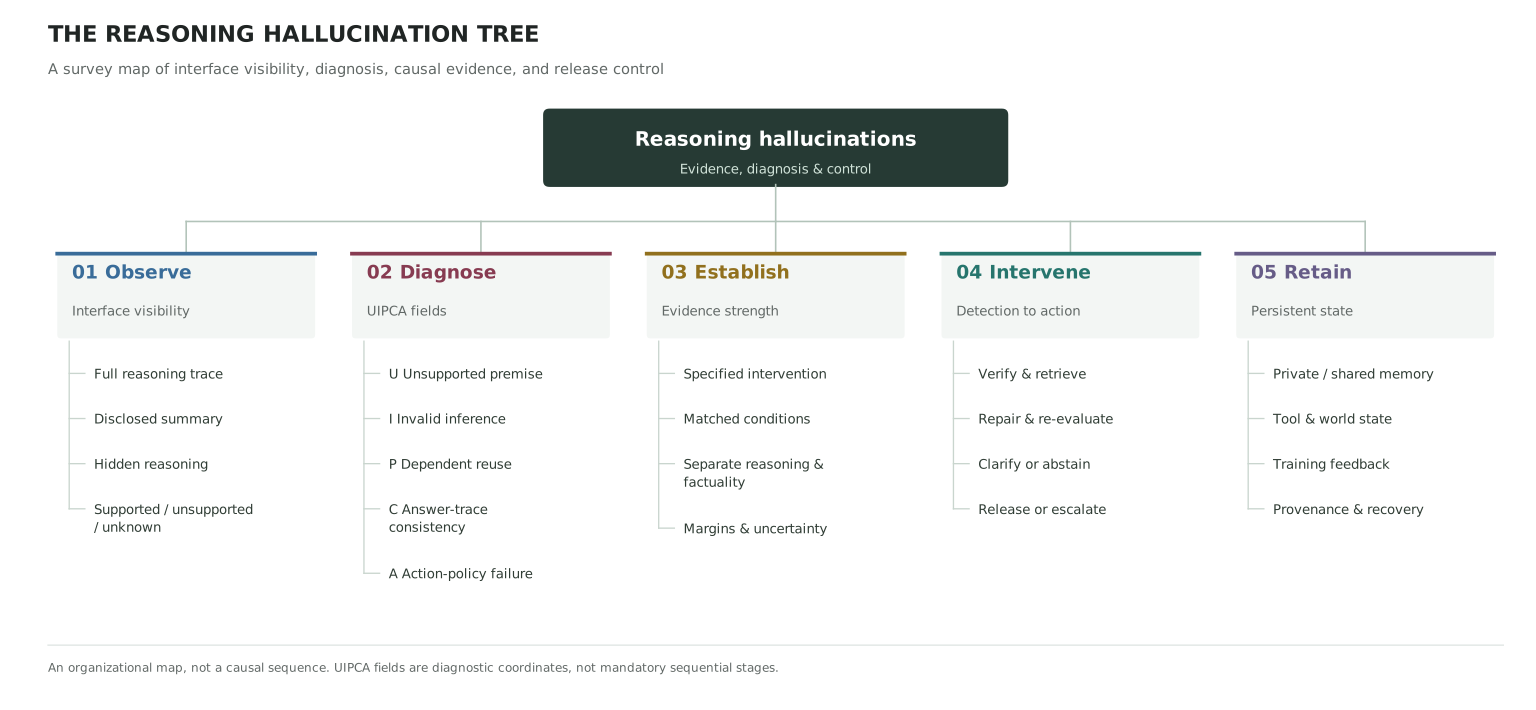
A wrong answer is not a diagnosis. UIPCA distinguishes unsupported premises, invalid inferences, dependent reuse of a confirmed error before repair, visible answer-trace consistency, and action-policy failure. These are independent diagnostic questions, not five stages. Visible consistency does not establish hidden reasoning.
Causal evidence requires a specified intervention, matched conditions, separate reasoning and factuality measures, thresholds, and uncertainty. Reviewed comparisons do not establish the joint adverse effect under that criterion. Unestablished does not mean harmless.
Full, summary, and hidden interfaces expose different evidence. Unknown is not absent. Evidence can support a repair; unresolved support may instead require abstention. Release and persistent writes require separate checks for evidence, authority, and provenance.
Reasoning errors can propagate into later decisions and memory. This survey synthesizes 312 papers and first-party reports on text-based reasoning hallucinations around three questions: what evidence is observable, what study designs establish, and which corrective actions the evidence supports.
UIPCA records unsupported premises (U), invalid inferences (I), dependent reuse (P), visible answer-trace consistency (C), and action-policy failures (A). Across 58 reviewed sources, no comparison establishes that a specified intervention improves reasoning while reducing factual reliability under matched conditions.
The synthesis connects diagnosis to verification, repair, selective release, and persistent-state control across memory, tools, and training feedback.
Five connected perspectives on the path from a claim to a consequential decision.
An overview of the survey's organization. UIPCA fields are diagnostic coordinates; they do not imply that every run follows five sequential stages.
A visible rationale is generated text. Its consistency and its causal role are different questions.
Ordered steps permit local support checks, inference checks, and inspection of visible dependencies.
Visible structure does not establish the mechanism of hidden computation.
Disclosed claims can be checked against the task and its evidence, with a partial view of the process.
Omitted steps remain unobserved; they cannot be marked error-free.
The prompt, designated evidence, answer, and observed action support output and policy checks.
Unavailable process diagnostics remain unknown, rather than zero.
Study design, joint outcome measurement, and statistical reporting are assessed separately.
No positive source emerged when only threshold and uncertainty-reporting requirements were relaxed. This leaves the specified trade-off unresolved; it does not establish absence of harm or a field-wide zero.
| Where evidence is limited | What the study can establish |
|---|---|
| 01Control designSeveral factors change together. | Results describe the combined system difference. They cannot isolate the effect of the specified intervention. |
| 02Joint measurementReasoning and factuality are not measured separately. | A controlled result can still be informative, but it cannot answer whether reasoning improves while factual reliability declines. |
| 03Statistical reportingBoth outcomes exist; margins or uncertainty are incomplete. | Relevant experimental evidence remains valuable. It is insufficient to confirm the strict joint criterion. |
The collection is curated, not an exhaustive census. Three external leads with unavailable primary text remain pending.
The survey links process diagnosis, causal evidence, and decisions about release and persistent state.
Unsupported premises, invalid inferences, dependent reuse, visible answer-trace consistency, and action-policy failures identify distinct repair points.
Five falsifiable hypotheses connect the reviewed evidence to proposed experiments. Matched interventions are needed to attribute a joint change in reasoning and factuality.
Release and write decisions require different checks. Memory, tool state, and training feedback also need evidence binding, authority checks, versioning, and downstream recovery.
UIPCA records confirmed failures (1), ruled-out failures (0), or insufficient evidence (unknown). Repetition alone does not establish dependent reuse, and consistency alone does not establish factuality.
Verification and repair inform release. State-changing actions also require evidence, authority, and version checks.
Report selective risk together with coverage, repair success, review workload, and cost.
Preserve unknowns, check write authority and versions, and record provenance.
Correcting a stored record does not by itself repair derived summaries, actions, or feedback.
arXiv:2610.05472 [cs.AI], 2026.
@misc{yu2026hallucinationreasoninglifecycleinterface,
  title = {Hallucination Across the Reasoning Lifecycle:
    Interface Visibility, Causal Evidence, and Release
    Control in Large Reasoning Models},
  author = {Zhe Yu and Mohan Li and Lei Yu and
    Ka-Ho Chow and Chengwei Qin and Xingyu Wu and
    Wenpeng Xing and Shuguang Xiong and Meng Han},
  year = {2026},
  eprint = {2610.05472},
  archivePrefix = {arXiv},
  primaryClass = {cs.AI},
  url = {https://arxiv.org/abs/2610.05472}
}